Growth for an OMS vendor slows when integration work multiplies. Every new customer, region, and sales channel adds more platforms to connect and more APIs to manage. A Unified API for Order Management Systems offers a different path. You integrate once, use a consistent model for orders and inventory, and extend coverage by configuration instead of rework. appse ai gives OEMs that unified layer so they can stay focused on product, not plumbing.
OEMs, OMS, And The New Integration Reality
OEMs As The Hidden Backbone Of Modern Order Management
Original Equipment Manufacturers now deliver software components that others package into complete OMS offerings. They ship modules for order capture, inventory logic, shipping workflows, and related functions that become part of each partner’s platform. The OEM relationship works when those modules stay reliable, easy to embed, and simple to connect with the rest of the stack.
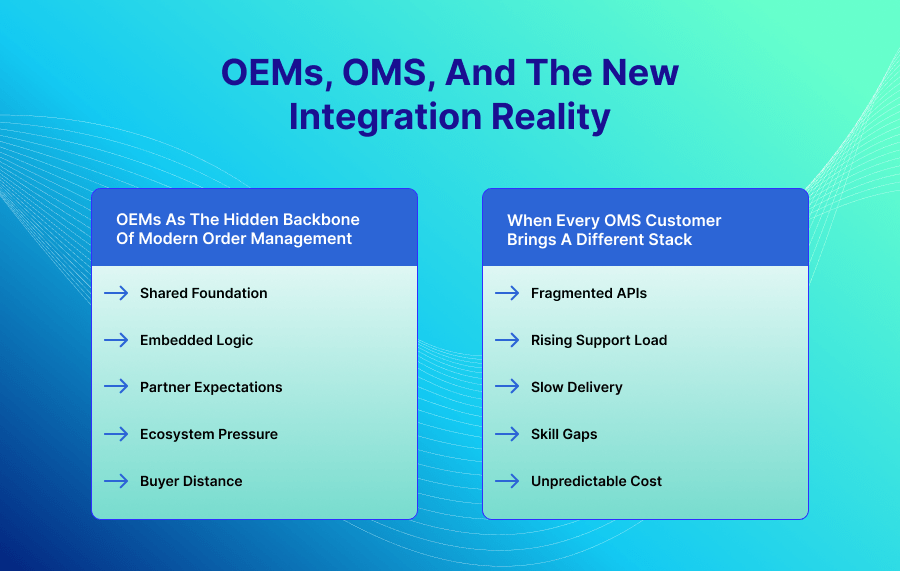
- Shared Foundation: OEM capabilities power many OMS products that carry different brands and user interfaces.
- Embedded Logic: Complex rules for routing, allocation, and approval often live inside OEM components.
- Partner Expectations: OMS vendors expect these components to work in many customer environments without custom rewrites.
- Ecosystem Pressure: New channels and regions keep adding integration demands to the OEM roadmap.
- Buyer Distance: End customers judge the OMS experience, even when OEM components carry the real workload.
When Every OMS Customer Brings A Different Stack
- Fragmented APIs: Every additional connector introduces its own methods and error patterns.
- Rising Support Load: Incidents often trace back to one of many fragile point-to-point flows.
- Slow Delivery: New customers wait while teams extend or repair existing integrations.
- Skill Gaps: Finding engineers who understand each external system slows hiring and onboarding.
- Unpredictable Cost: Integration work is hard to estimate and harder to reuse across customers.
What Is A Unified API For Order Management Systems?
For OEMs, an OMS unified API becomes the stable interface they rely on; the appse ai unified API turns that concept into a practical, maintainable product capability.
From Individual Connectors To A Single, Normalized API
- Single Contract: The OMS connects to one API model instead of many separate schemas.
- Shared Logic: Common rules for retries, mapping, and error handling live in one place.
- Provider Abstraction: Adding a new platform requires configuration and mapping, not a fresh codebase.
- Central Governance: Teams can review and improve integrations without searching through scattered services.
- Simpler Testing: One suite of tests protects behavior across all supported platforms.
How Unified APIs Support OMS Speed, Stability, And Reach
A unified approach shifts integration from ad-hoc tasks to a planned capability. OEMs and OMS vendors gain a predictable way to reach more systems without exploding complexity. They can add channels and regions through configuration, not from scratch, while keeping behavior consistent for operations teams.
- Faster Delivery: New connectors borrow the same patterns instead of reinventing flows.
- Stable Interfaces: The OMS talks to one contract even when providers release new API versions.
- Controlled Expansion: Teams can roll out support for new platforms in phases, with clear impact.
- Cleaner Incident Response: Operations sees one integration layer to inspect, monitor, and improve.
- Better Roadmap Focus: Product teams allocate more time to OMS features, less to survival work.
Why OEMs Need Unified APIs: appse ai’s Take
OEMs that support OMS vendors now face an integration-heavy future. Every partner expects more channels, more automations, and more ways to connect orders with finance and logistics. Without a unified approach, these OEMs end up running many separate connectors that constantly demand attention. appse ai’s unified API changes that pattern.
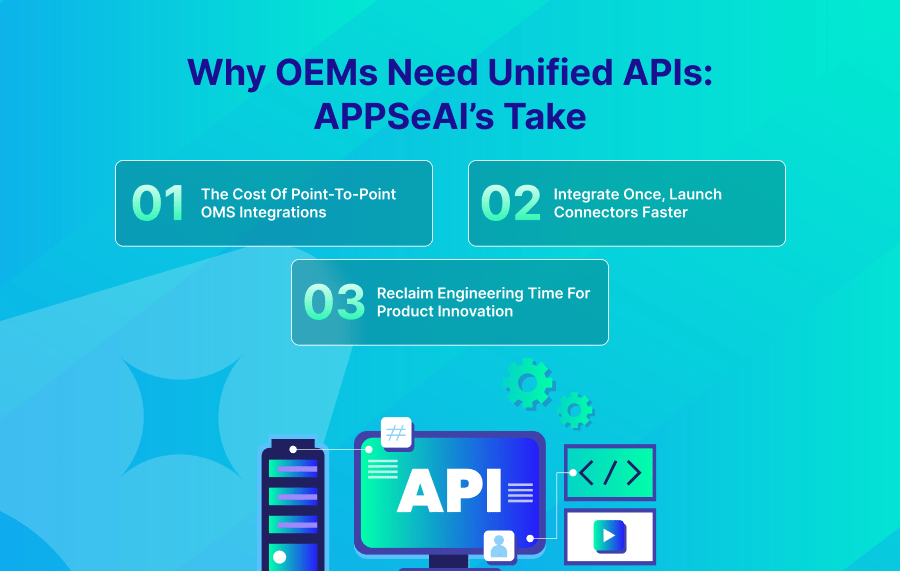
The Cost Of Point-To-Point OMS Integrations
Point-to-point integrations appear simple at the start. Over time, they create a patchwork of services that evolve at different speeds. The result is hard to change and even harder to explain. For OEMs, that patchwork also makes each new OMS partner look like a new project.
The benefits of unified API for order management systems show up in lower integration debt, faster onboarding, and more predictable operations.
- Duplicate Work: Similar logic for orders and stock must be rebuilt for each platform.
- Version Drift: Some connectors run on old API versions because upgrades feel risky.
- Inconsistent Quality: Certain flows behave differently because they were built under pressure.
- Invisible Debt: Integration code grows while documentation and ownership lag behind.
- Slower Sales: Complex integration stories make evaluation harder for cautious OMS buyers.
Integrate Once, Launch Connectors Faster
With appse ai’s unified API, OEMs integrate once into a single interface that already understands ecommerce and OMS patterns. That interface becomes the bridge between the OEM’s capabilities and the external systems that support each OMS deployment. Instead of writing new connectors, teams map new endpoints into the unified layer.
- Single Integration Effort: One deep integration replaces many shallow but fragile ones.
- Reusable Mappings: Data transformations apply to many platforms with only small adjustments.
- Shared Observability: Logs and metrics live in one place, not across scattered services.
- Faster Certification: New connectors reuse a known architecture during partner reviews.
- Shorter Onboarding: OMS vendors can list supported integrations earlier in the sales process.
Reclaim Engineering Time For Product Innovation
Unified APIs free OEMs from constant integration firefighting. When integration work moves into a shared layer, engineering teams can return to the core OMS value: better routing logic, smarter stock rules, improved analytics, and richer workflows. appse ai’s focus is to give that time back.
- Stronger Product Roadmaps: Teams ship more features that end customers actually notice.
- Less Reactive Work: Integration incidents follow standard paths instead of urgent, one-off fixes.
- Better Talent Use: Specialists work on strategy and design, not constant patching.
- Clearer Ownership: One integration layer has defined roles and review practices.
- Higher Partner Confidence: OMS vendors see a stable foundation rather than a fragile set of scripts.
Unified Advantages For OMS OEMs With appse aiI’s Unified API
appse ai’s unified API gives OEMs and OMS vendors a way to support diverse environments without rebuilding their integration story for every buyer. They gain a consistent platform for order, inventory, and customer data flows that can scale across sectors and geographies. That stability becomes a long-term advantage.
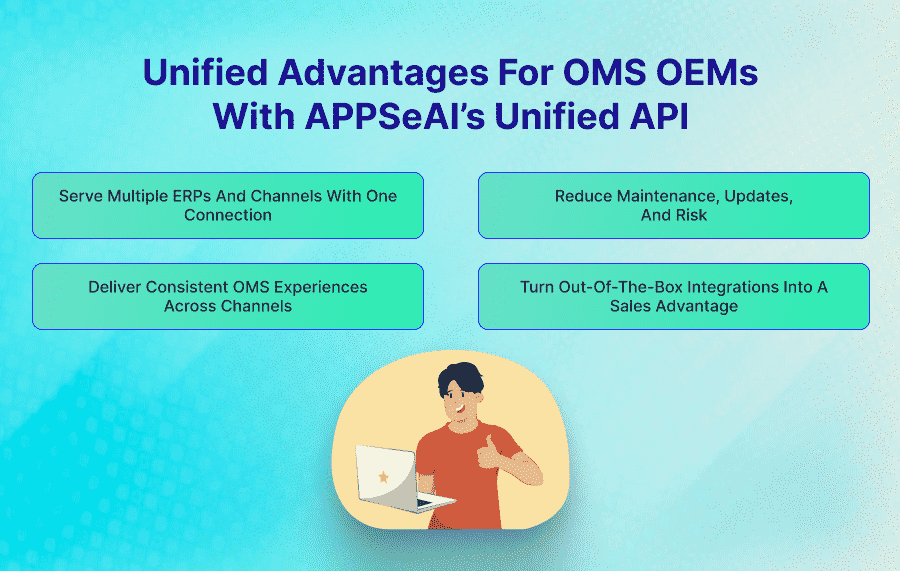
Serve Multiple ERPs And Channels With One Connection
OMS vendors rarely connect only one system. They must work with many ERPs, ecommerce platforms, and service providers. appse ai’s unified API offers a single touchpoint for these categories so OEMs do not carry individual connectors for each combination. This single layer also simplifies ERP and OMS integration, so order, inventory, and financial data move through one governed path instead of many ad-hoc links.
- Broader Coverage: Support many back-office and channel platforms through one shared layer.
- Standard Order Model: Orders use a consistent structure from capture to completion.
- Aligned Inventory View: Stock levels follow the same logic everywhere they appear.
- Unified Customer Data: Identifiers and profiles remain coherent across OMS, sales, and service.
- Simpler Partner Messaging: Integration capabilities are easier to describe and position in deals.
Reduce Maintenance, Updates, And Risk
appse ai centralizes integration updates. When platforms adjust their endpoints or introduce new rules, those changes are handled inside the unified layer. OEMs and OMS vendors avoid touching many scattered connectors, which reduces regression risk and protects uptime.
By centralizing change, teams reduce OMS integration costs with unified ecommerce API patterns instead of fixing the same issues across dozens of point connectors.
- Fewer Touchpoints: One update path instead of many small services to patch.
- Safer Changes: Reusable patterns and shared tests keep regressions contained.
- Predictable Cycles: Planned maintenance windows replace urgent, unplanned changes.
- Lower Long-Term Cost: Integration no longer drives constant engineering rework.
- Stronger Reliability: Tested integrations behave consistently under peak demand.
Deliver Consistent OMS Experiences Across Channels
End customers expect a stable order journey across all touchpoints. A unified API helps OEMs deliver that experience through each OMS partner, even when the underlying systems differ. Orders, refunds, and status updates follow the same rules everywhere. For many teams, treating the unified layer as a multi-channel order management API and unified ecommerce API keeps experiences aligned even as channels expand.
- Aligned Status: Order stages look familiar in every channel the OMS supports.
- Clear Tracking: Shipment events share a similar structure across carriers.
- Stable Policies: Cancellation and refund logic stay aligned across regions.
- Confidence For Service Teams: Support staff rely on one pattern for investigating cases.
- Less Training Overhead: New staff learn common flows instead of case-by-case rules.
Turn Out-Of-The-Box Integrations Into A Sales Advantage
Enterprise buyers now expect OMS platforms to arrive with integrations ready. appse ai enables OEMs to embed unified connectivity so OMS vendors can offer those integrations as part of their base proposition. That readiness removes friction during evaluation.
Unified connectivity also helps accelerate OMS time to market with unified API integration that is ready to demo and deploy from day one.
- Shorter Sales Cycles: Ready connectors help answer integration questions early.
- Faster Go-Lives: Customers spend less time designing basic data flows.
- Clear Differentiation: OMS vendors present integration as a strength, not a risk.
- Partner Trust: Buyers see a mature, repeatable approach instead of one-off projects.
- Easier Expansion: New sites or regions reuse the same underlying integration logic.
Embedded Integrations: Bringing Unified Connectivity Inside Your OMS
Embedded integrations put unified connectivity where users already work. Instead of jumping between consoles, operations teams manage orders, stock, and fulfillment from their OMS interface. appse ai’s unified API becomes the engine behind those in-product experiences. Embedded integrations for OMS products help teams manage channels and back-office systems without leaving their daily screens.
What Embedded Integration Looks Like For OMS Vendors
When appse ai is embedded, users see OMS screens that already understand their channels and back-office systems. They can sync orders, push updates, and review issues without leaving the product. The unified API handles the heavy lifting behind the scenes.
Embedded OMS integrations with ERP and ecommerce platforms make the OMS feel like a complete operational hub rather than another disconnected tool.
- In-Product Actions: Teams create and sync records without external dashboards.
- Contextual Views: Order and inventory details appear alongside integration status.
- Cleaner Workflows: Operations follow direct paths instead of manual tool switching.
- Shared Controls: Admins manage connections and rules from within the OMS settings.
- Tight Feedback Loop: Integration issues surface as part of normal OMS monitoring.
Adoption, Retention, And All-In-One Buyer Expectations
Customers prefer platforms that solve their integration needs without additional tools. Embedded unified integrations help OMS vendors meet that expectation. They reduce friction during onboarding and support deeper usage over time.
- Simpler Onboarding: Fewer external components for customers to understand and configure.
- Higher Daily Use: Users engage more when they can complete flows in one place.
- Lower Churn Risk: Dependence on embedded integrations makes the OMS harder to replace.
- Upsell Potential: Extra channels and flows can become clear expansion paths.
- Stronger Brand Position: The OMS presents as a complete hub, not just part of a stack.
Real-World Use Cases: appse ai Empowering OMS
Order management success depends on accurate stock, reliable fulfilment, and clean financial handling. appse ai’s unified API supports OMS vendors across these domains. The same foundation that consolidates integrations also drives practical improvements in daily operations. For retail and omnichannel teams, the unified layer behaves like a unified commerce API for retail, tying together stores, marketplaces, and digital channels.
Real-Time Inventory Synchronization Across Channels
In high-volume environments, stale inventory data leads to oversells and customer frustration. With a unified API, OMS vendors can maintain a trustworthy picture of stock across all channels. Updates flow quickly whenever orders reserve units or warehouses receive goods. appse ai effectively acts as an ecommerce OMS connector, standardizing ecommerce order management integration across storefronts, marketplaces, and retail systems.
- Aligned Quantities: Salable stock reflects both physical counts and active reservations.
- Fewer Oversells: Orders use consistent rules to check and reserve inventory.
- Better Promises: Delivery estimates improve when stock and locations stay accurate.
- Simpler Replenishment: Planning teams see a clear picture of demand across channels.
- Lower Support Load: Fewer stock disputes reach the service queue.
Automated Shipping, Labeling, And Tracking
Shipping tasks often rely on manual steps and repeated data entry. appse ai’s unified API helps OMS vendors automate carrier interactions so teams spend less time copying information and more time resolving exceptions.
- Label Creation: Shipping labels generate from the same core order data.
- Carrier Calls: The unified layer talks to supported carriers through shared patterns.
- Tracking Updates: Customers receive timely tracking events from connected systems.
- Reduced Errors: Automated data flows leave fewer chances for copy-paste mistakes.
- Faster Throughput: Warehouses process more orders in the same time window.
Unified Payments, Refunds, And Reconciliation
Handling payments and refunds across platforms becomes complicated as volumes rise. A unified API gives OMS vendors a single way to represent these financial events, which simplifies reconciliation and reporting.
- Aligned References: Payments and refunds link cleanly back to original orders.
- Clear Audit Trails: Financial events move with consistent identifiers and notes.
- Reduced Disputes: Customers see clear refund handling and status updates.
- Simpler Close: Finance teams rely on structured data instead of manual exports.
- Trusted Reports: Leaders get consistent numbers from month to month.
Customer Data, Personalization, And Compliance
Customer profiles often spread across many systems. appse ai’s unified API helps OMS vendors keep identities and preferences better aligned. That consistency supports both service quality and compliance expectations.
- Coherent Profiles: Customer identifiers match across OMS, channels, and service tools.
- Accurate History: Order timelines stay complete even when channels differ.
- Targeted Engagements: Campaign tools can trust shared data from the OMS layer.
- Preference Handling: Consent and opt-out choices follow customers across touchpoints.
- Risk Controls: Suspicious activity checks benefit from a broader view of behavior.
Demand Forecasting, Returns, And Smart Order Routing
Predictive and optimization features depend on clean, connected data. By routing that data through a unified API, OMS vendors gain a reliable base for forecasting, returns, and routing decisions.
- Better Forecasts: Demand signals arrive in a structured, comparable format.
- Faster Returns: Return flows reuse the same order information for decisions and restocking.
- Smarter Routing: Orders route to the best fulfilment source based on defined rules.
- Improved Margin: Shipping and handling choices factor in cost and service goals.
- Continuous Learning: Performance data feeds back into routing strategy.
A Practical Path To Unified API Adoption
Moving to a unified API does not require a disruptive rebuild. OMS OEMs can start with focused flows, learn from real usage, and expand. appse ai supports this path with guidance and tooling designed for gradual rollout. Over time, appse ai became the OMS SaaS integration platform that underpins enterprise OMS integration across regions, brands, and partner ecosystems.
Map Bottlenecks And High-Impact OMS Workflows
The first step is to understand where integration pain appears most often. Teams should look at order delays, repeated manual tasks, and frequent incident types. These findings reveal where a unified API will have the fastest, clearest impact.- Identify Delays: Track where orders or updates regularly slow down.
- Study Exceptions: Group recurring integration issues by pattern and cause.
- Assess Manual Work: List tasks that still rely on copy-paste or spreadsheets.
- Rank Workflows: Prioritize flows that affect revenue or customer experience most.
- Set Initial Goals: Define simple success measures for early unified API work.
Run A Focused Unified API Pilot
After selecting one or two key workflows, OMS vendors can run a pilot using appse ai’s unified API. The goal is to prove that a single interface can replace several connectors while improving stability. Using low code OMS integration patterns, teams configure flows quickly instead of writing and maintaining large new services.
- Narrow The Scope: Choose a limited set of channels and systems for the pilot.
- Use Low-Code Tools: Configure flows instead of writing large new services.
- Monitor Closely: Track performance, exceptions, and user feedback from day one.
- Refine Mappings: Adjust data shapes and rules as real cases appear.
- Document Lessons: Capture what worked and what needs adjustment for scale.
Measure Results, Then Expand Across Platforms And Regions
With pilot results in hand, teams can decide how and where to extend unified API use. They can add more systems, extend to new regions, or bring additional OMS partners onto the same foundation. Pilot results often show how much you improve OMS scalability with unified order management API patterns compared to traditional point-to-point designs.
- Review Outcomes: Compare pilot metrics with the starting baseline.
- Confirm Fit: Check that teams find the new flows easier to operate.
- Plan Rollout: Sequence new platforms and regions with clear milestones.
- Update Playbooks: Turn pilot steps into reusable onboarding guides.
- Scale Confidently: Use the unified layer as a standard for future integrations.
How To Engage With appse ai
appse ai works with OMS OEMs and vendors that want a clearer integration story. The team helps identify pain points, map them to unified API capabilities, and plan realistic pilots. From there, partners can standardize on a model that supports future expansion. To begin, you can reach the team at growth@appseconnect.com or through the APPSeAI contact form.
Conclusion
A Unified API for Order Management Systems gives OEMs and OMS vendors a stable foundation for their next phase of growth. Instead of juggling many fragile connectors, they work with one consistent interface that supports orders, inventory, customers, and fulfillment. appse ai provides that unified layer, built to reduce integration debt and support embedded experiences. Start with a focused pilot, prove the outcomes, then expand calmly. The result is an OMS ecosystem that scales with less friction and more confidence.
What Is A Unified API For Order Management Systems?
A single API that standardizes orders, stock, and related data across many platforms and providers.
How Is A Unified API Different From Separate OMS Integrations?
You integrate once into a consistent model instead of maintaining many platform-specific connectors separately.
Which OMS Use Cases Benefit Most From A Unified API Approach?
High-volume ordering, stock synchronization, shipping workflows, refunds, and routing decisions benefit heavily from unification.
How Does A Unified API Reduce OMS Integration And Maintenance Costs?
Central changes, reusable mappings, and shared monitoring replace scattered services and constant connector rework.
Can APPSeAI’s Unified API Support Multi-Channel Ecommerce Order Management?
Yes, it is designed to handle orders, stock, and related flows across many sales channels.
What Role Do Embedded Integrations Play Inside An OMS Product?
They bring syncing, monitoring, and control directly into OMS screens, which improves daily usability and adoption.
How Does A Unified API Improve OMS Scalability And Future Readiness?
You can add platforms, channels, or regions through configuration instead of rebuilding integrations from scratch.
What Security And Compliance Safeguards Apply To Unified API-Driven Order Flows?
Rules for risk checks, access control, and consistent logging help align operations with platform and regional expectations.
How Should An OEM Start A Unified API Pilot For Its OMS?
Select a painful workflow, run a small pilot with APPSeAI, measure outcomes, then refine and expand.
How Can We Talk To APPSeAI About Unified API Options For Our OMS?
Contact the team at growth@appseconnect.com or use the form on the APPSeAI engagement page.
Leave a Reply