What is an AI Workflow?
An AI workflow is a set of steps that use artificial intelligence to get work done from start to finish. It pulls together your data, applies rules for making decisions, and triggers actions along the way. Tasks move forward without someone having to push them manually at every stage. Even when the incoming data is inconsistent or the volume spikes, the process keeps running the way it should.
In a traditional workflow, rules decide what happens next. In an AI workflow, the system can also classify, extract, predict, and recommend. That makes the process more flexible, especially when the next step depends on context, not only on a fixed rule.
Most teams build AI workflows to cut delays and rework. The workflow stays auditable because it records what happened and why. Over time, the best workflows become an operating habit, not a special project.
What is AI Workflow Automation?
AI workflow automation is putting AI to work on the steps that would otherwise need a person to handle them. It can go through documents, fill in missing details in your records, send cases to the right team, or put together draft replies. But people stay in charge when it comes to giving approvals or dealing with unusual situations. What makes it useful over time is that the system learns as it goes, so the workflow gets better the more it runs.
An AI workflow automation setup usually follows a loop. Data enters, AI proposes an output, and rules decide what to do with it. The workflow then executes an action, logs the outcome, and captures feedback. The feedback helps the model improve and helps the workflow become more reliable.
This is not “AI everywhere.” It is targeted automation using AI where it adds clarity or speed. The best systems keep scope tight and keep decisions explainable. That makes adoption easier and makes operations calmer.
How does it differ from Standard Automation?
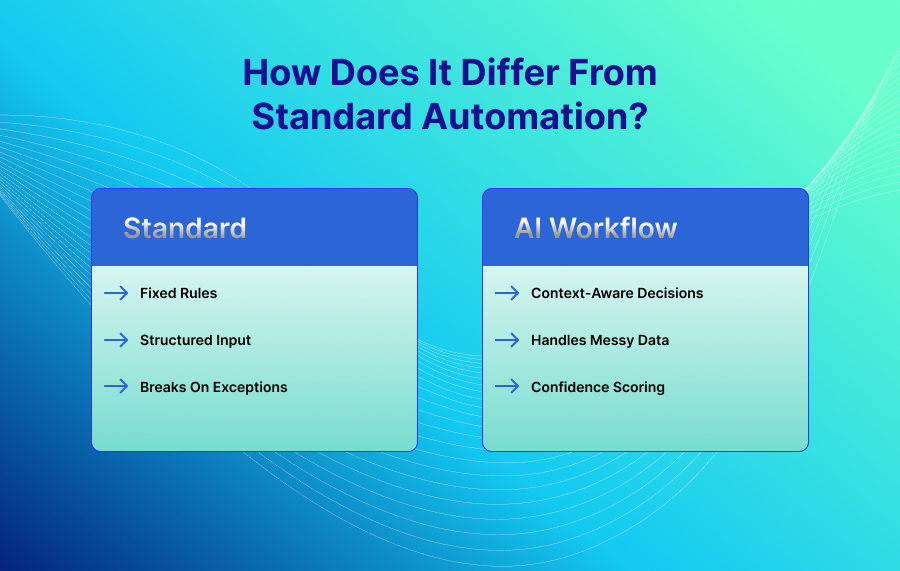
Standard automation works best when inputs are consistent and rules rarely change. You define conditions, and the system follows them exactly. If the input is incomplete, the automation often fails or requires a manual fix.
AI workflow automation adds a decision layer that can interpret messy inputs. It can extract fields from unstructured text, match records, or estimate confidence. That makes the workflow usable in real scenarios like emails, invoices, support tickets, and product catalogs.
The key difference is how uncertainty is handled.
Regular automation breaks down when processes change because you have to keep rewriting the rules. AI based automation handles change better, but only if you set boundaries and keep an eye on it. Without guardrails, the workflow starts doing unexpected things. Once that happens, people stop trusting it.
Running AI adds to your list of responsibilities. The information feeding into the system has to be reliable, or everything downstream suffers. Models do not stay reliable forever, they can drift and start producing weaker results over time. Bias is another risk that needs active monitoring before it affects real decisions. And beyond all that, you need a proper way to verify that the outputs are actually right. This is exactly why managing the workflow end to end is just as important as which model you decide to go with.
What are the Components of AI Workflow Automation?
AI workflow automation succeeds when it is built like an operating system. Each component has a role, and the system remains stable when components evolve. A strong design does not rely on one clever model. It relies on clean inputs, clear triggers, safe actions, and measurable outcomes.
1. Data Inputs & Preparation
Data inputs include everything the workflow receives, such as forms, emails, transaction records, or sensor events. Preparation makes those inputs usable. It removes duplicates, standardizes formats, and resolves identities across systems. If this step is weak, errors spread downstream.
Preparation also sets the boundary of what the AI should see. Sensitive fields should be masked when they are not required. Text should be normalized so extraction is consistent. When data preparation is disciplined, automation using AI becomes safer and more accurate.
2. AI Models & Algorithms
The AI model is the component that produces predictions, classifications, summaries, or extracted fields. It can be a language model, a vision model, or a traditional machine learning model. The model should be chosen for the task, not for hype.
A model should also produce confidence signals. Confidence helps the workflow decide when to act and when to ask a human. When the model output is treated as a suggestion and not as a fact, the workflow stays reliable.
3. Triggers & Conditions
Triggers determine when a process starts running. This could be an event like a customer placing an order, or following a schedule, such as a batch process that runs every evening. Once the workflow is moving, conditions take over and guide it down the correct path. These conditions apply your business rules and factor in the model’s confidence. Without this structure, workflows become unpredictable. With it, you stay in control.
Good triggers are specific and stable. They avoid running the workflow too often, and they avoid missing important events. Good conditions are explainable, so teams can trust why a case was routed or why an action was executed.
4. Integration
Integration connects the workflow to the systems that hold data and execute actions. This includes ERP, CRM, eCommerce, ticketing, finance, and analytics tools. Integration keeps identifiers consistent and keeps status synchronized across systems. Without integration, the workflow becomes a local fix rather than a business capability.
Integration also needs error handling. Retries should be safe and should not create duplicates. Logs should capture what happened and what failed. This is how an artificial intelligence workflow stays operable under load.
5. AI Agents
AI agents are components that can plan and execute multi-step tasks within guardrails. They can decide which tools to use, retrieve context, and attempt resolution before escalating. Agents are useful when the workflow requires reasoning across multiple sources, such as resolving a customer issue with order history and shipment status.
Agents must be constrained. They need clear permissions, clear boundaries, and a safe escalation path. When an agent can act without control, risk rises quickly. When the agent is guided by policy and monitored, it becomes a productivity tool rather than a liability.
6. Orchestration Layer
The orchestration layer coordinates steps across the workflow. It manages ordering, retries, timeouts, and parallel processing. It also manages approvals, so people can intervene where judgment is required. Orchestration is what turns a collection of actions into a reliable process.
Orchestration also supports observability. It tracks which step ran, how long it took, and what outcomes were produced. This is central to AI workflow tools that enterprises rely on, because reliability is measured, not assumed.
What are the Benefits of AI Workflow Automation?
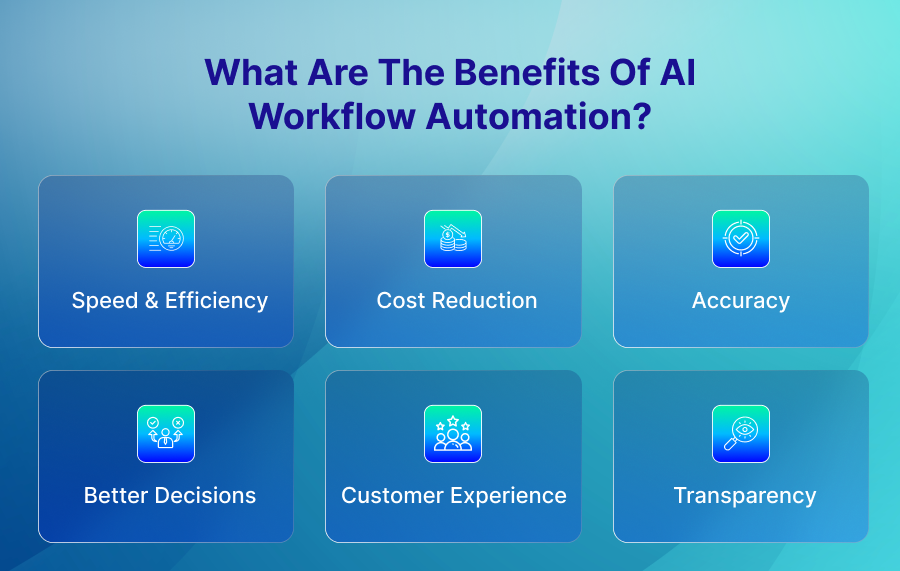
AI workflow automation is adopted because it changes daily work, not because it sounds modern. The benefits show up as shorter cycle time, lower error rate, and clearer status. They also show up as calmer teams, because exceptions are handled consistently.
Efficiency and Speed
Efficiency improves when repetitive steps are completed automatically and consistently. AI can extract, classify, and route in seconds, reducing the time people spend on triage. Work moves forward without waiting for manual copy and paste.
Speed is not only about processing. It is also about decision timing. When a workflow surfaces the right context quickly, people decide faster. That reduces queue buildup during peak periods.
Cost Savings
Cost savings come from fewer manual touches and fewer rework cycles. When errors are prevented early, the downstream costs of correction decline. When exceptions are routed with context, resolution time drops.
Savings also come from better utilization. Teams spend more time on high-value work. They stop doing tasks that are essentially data movement and validation.
Improved Accuracy & Consistency
AI helps reduce variability when tasks depend on reading and interpreting inputs. It can apply the same extraction logic to every document and the same classification logic to every message. Combined with validation rules, this reduces common mistakes.
Consistency also improves compliance. When workflows execute the same steps with the same evidence, audits become easier. The system can show what happened without reconstructing history from emails.
Better Decision-Making
AI can highlight risks, propose next actions, and summarize context. This improves decision quality because people see the relevant signals sooner. It also reduces cognitive load, because the workflow filters noise.
Decision support is most valuable when it is measurable. Teams can compare outcomes before and after the workflow. They can refine thresholds and policies based on evidence.
Improved Customer Experience
Customer experience improves when status is accurate and responses are timely. AI can draft messages, suggest resolution paths, and route urgent cases. It can also keep customers informed through automated updates that reflect real progress.
A better experience also reduces cost. Fewer customers contact support when they see clear status. Fewer disputes occur when invoices and shipments align. The workflow becomes a service improvement tool.
Transparency & Insights
A good workflow produces visibility. It shows where work is stuck, which exceptions repeat, and which steps consume time. This helps teams improve processes rather than only processing more tickets.
Transparency also supports governance. It becomes easier to explain how decisions were made. It becomes easier to show that sensitive actions were controlled and reviewed.
4 Layers of an AI Workflow
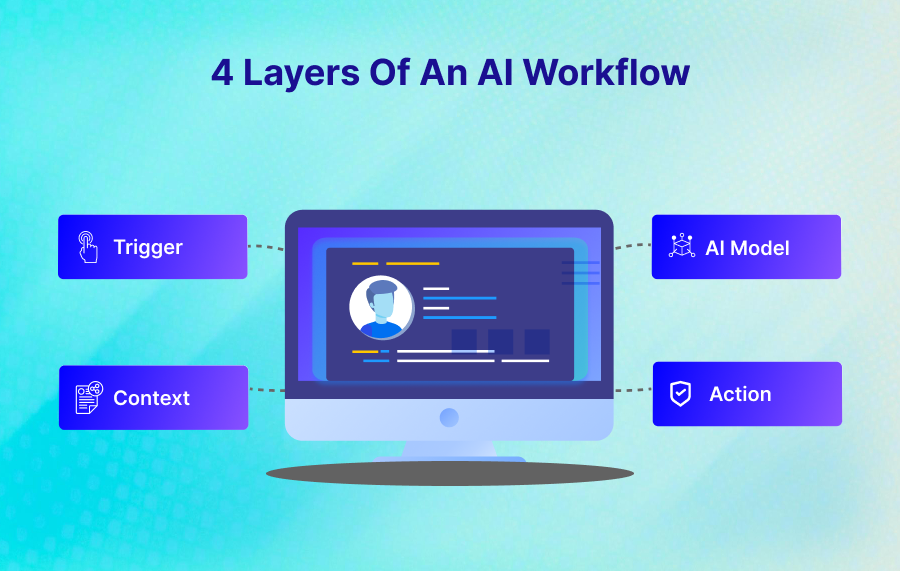
A helpful way to design an AI workflow is to think in layers. Each layer has a clear responsibility. When the responsibilities are separate, the workflow is easier to debug and easier to evolve.
Layer 1: Trigger
The trigger layer decides when the workflow starts. It can be an event like a new order, or a schedule like a nightly run. The trigger should be reliable and should include enough context to route correctly.
Good triggers reduce noise. They avoid starting workflows that will immediately fail due to missing prerequisites. They also prevent missed events that create backlog.
Layer 2: Context
The context layer gathers what the AI needs to make a useful decision. It pulls customer history, order details, policy rules, and prior outcomes. Context also includes constraints, such as what the workflow is allowed to do.
This layer is where relevance is created. Without context, AI produces generic output. With context, AI can produce targeted, actionable output that matches the business process.
Layer 3: AI Model
The model layer produces the intelligence. It may extract fields, classify intent, estimate risk, or draft a response. The output should include confidence signals and should be easy to validate.
The model layer should not own business policy. Policy belongs in the workflow and orchestration. When policy is outside the model, changes are safer and audits are easier.
Layer 4: Action
The action layer executes what the workflow decides. It updates records, routes tasks, sends messages, or triggers downstream systems. Actions should be logged, reversible where possible, and constrained by permission.
Action is where value is realized and where risk lives. That is why actions should be designed with safeguards and approvals. When action is controlled, AI becomes a safe productivity multiplier.
How to Implement AI Workflows in Your Organization?
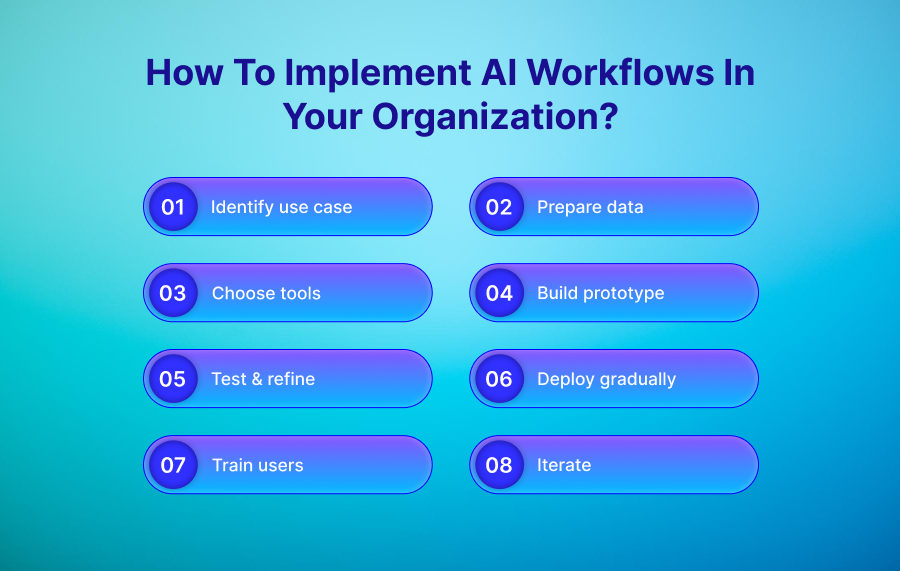
Implementation succeeds when it is phased and measurable. Start with a narrow use case, build a prototype, then expand. Keep governance simple but explicit, and keep the system observable from day one.
1. Identify High-Impact Use Cases
Choose use cases where manual work is high and where errors are costly. Look for repetitive tasks with clear inputs and clear outcomes. Examples include invoice intake, order exceptions, support triage, and catalog enrichment.
A good use case also has a clear owner. If no team owns outcomes, the workflow will drift. Ownership is what turns a prototype into a durable system.
2. Gather and Prepare Data
Collect the inputs and define their structure. Clean the data, standardize formats, and resolve identifiers. Decide what fields are allowed and what fields must be masked. Data preparation is where many failures are prevented.
Preparation also includes feedback signals. Define what success looks like and how it will be recorded. Feedback is what keeps the workflow improving instead of stagnating.
3. Choose the Right Tools
Choose tools that match your environment and your governance needs. Some teams need cloud services, others need hybrid deployment. Some need strong connectors, others need stronger orchestration. Choose based on reliability, observability, and permissions.
This is where AI workflow tools matter. The best tool is the one your team can operate daily. If the tool is powerful but opaque, adoption will stall.
4. Build a Prototype Workflow
Start with a simple end-to-end slice. Implement trigger, context, model, and action for one narrow case. Keep the workflow readable so non-technical stakeholders can review it. Avoid trying to solve every edge case at once.
A prototype should include guardrails. It should include safe actions and clear escalation. This keeps early failures small and easy to learn from.
5. Test and Refine
Test with real data and real scenarios. Include both happy paths and exceptions. Measure accuracy, latency, and error rate. Tune thresholds and refine prompts or models based on actual outcomes.
Testing should also include operational tests. Simulate outages and retries, and confirm that duplicates do not occur. Confirm that logs are complete. Operational readiness matters as much as model quality.
6. Deploy Gradually and Monitor
Start small and expand from there. Before going wide, get your dashboards in place so you can track whether data is current, how often the workflow runs, what is backing up, and which exceptions keep showing up. Every alert should have an owner, and that person should know the exact steps to take when something goes past the limit.
Taking it slowly lowers your risk and gives people time to trust the system. It also makes feedback clearer because you can tie any changes in performance to specific updates. Once the numbers start looking better, making the case to expand becomes much easier.
7. Train Users & Manage Change
Users need to understand what the workflow does and what it does not do. Train them on escalation paths, approvals, and how to correct exceptions. Provide short runbooks that explain common scenarios and expected actions.
Change management is not messaging only. It is building confidence. When users see consistent results and clear controls, adoption grows naturally.
8. Iterate and Expand
Once a workflow is stable, expand to adjacent use cases. Reuse the same patterns for triggers, context, and monitoring. Improve governance as scope grows, but keep governance practical.
Iteration should be evidence driven. Use metrics and post-incident reviews to refine the workflow. Over time, the workflow becomes an operating capability that supports multiple teams.
Use Cases for AI Workflow Automation
Customer support is a strong starting point because triage and response drafting are repetitive. An AI workflow can classify intent, retrieve context, and route to the right queue. It can draft a reply that an agent reviews, which improves speed without removing human judgment.
Finance operations also benefit. Invoice intake workflows can extract supplier details, match purchase orders, and flag exceptions. Expense review workflows can check policy rules and request missing details. These workflows reduce manual review volume and improve audit traceability.
Sales operations leverage processes to measure the leads, fill in gaps in contact records, and prepare for outreach. The workflow can bring together information from your Customer Relationship Management tools and marketing platforms, suggest what to do next, and add tasks to the calendar. With the right oversight in place, this keeps pipeline management consistent across the team.
Supply chain and inventory teams use AI workflows for exception management. The workflow can detect delayed shipments, flag stockout risk, and propose reallocation options. It can also draft supplier messages and route approvals based on policy.
HR workflows can use AI for document intake, policy guidance, and onboarding steps. The workflow can check completeness, route approvals, and generate reminders. These workflows reduce delays and improve the employee experience.
Across these use cases, the pattern is the same. Choose a clear outcome, keep actions safe, and use feedback to improve. That is how AI workflow management becomes a practical discipline rather than a vague ambition.
The Evolving Landscape of AI Workflows
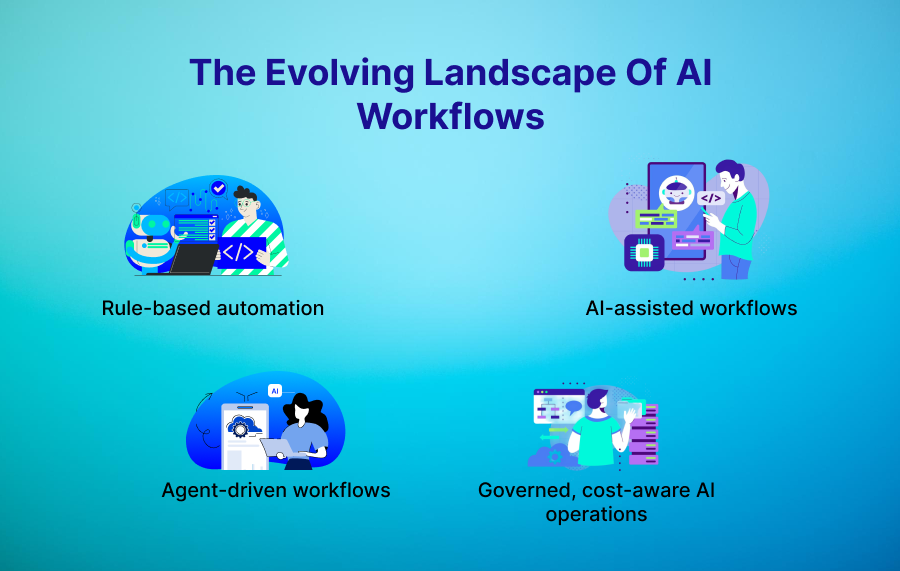
AI-based workflows are starting to act more independently. They can plan many steps and tasks under guardrails. They are learning to work with more than just text. Images, documents, and all major data formats can all flow through the same process now. This expands what can be automated, especially in document-heavy operations.
Governance is also becoming more central. Teams are adding approval layers, audit trails, and policy constraints. They are building controls for data access, prompt safety, and model selection. This is necessary because workflows increasingly touch sensitive data and high-impact actions.
Visibility into how workflows perform is improving, too. Companies are instrumenting workflows with metrics that resemble production systems: latency, error rates, throughput, and recovery time. When those metrics exist, teams can manage workflows like products, not experiments.
Finally, cost discipline is rising. Model usage costs can climb quickly at scale. Teams are therefore designing workflows that use AI only where it adds value, and they are using simpler automation elsewhere. This balance improves total cost of ownership and improves reliability.
In this landscape, the best approach is the one that stays stable, auditable, and easy to operate. The best approach is the one that provides standard patterns, stable operations, and safe change. With those foundations, AI can be adopted without turning the business into a lab.
Conclusion
An AI workflow is a structured process where AI helps make decisions and automation carries out the work in a controlled way. It performs best when the data going in is accurate, the triggers are well defined, the connections between systems are solid, and the actions it takes are safe. Pick one use case where the impact will be clear, track how it performs, and grow from there carefully. That way, each improvement builds on the last.
Leave a Reply