Enterprises today face a critical challenge of coordinating multipleaiagents working across different systems without creating chaos.
Traditional automation falls short when business processes require real-time decision-making, cross-functional collaboration, and adaptive responses.
Agenticaiorchestration solves this by acting as a conductor that coordinates autonomous AI agents. It helps the agents work together seamlessly across your ERP, CRM, and operational systems.
This is about creating an intelligent ecosystem where AI agents collaborate, learn, and execute complex workflows with minimal human intervention.
In this guide, we’ll walk you through everything you need to build safer, more scalable AI-driven workflows.
What is Agentic AI Orchestration?
Agentic AI orchestration is the process of coordinating multiple autonomous AI agents so they work together as a unified system, executing complex, multi-step workflows across different platforms and business functions.
Unlike simple automation that follows predetermined rules, agentic AI orchestration manages intelligent agents that can plan, reason, make decisions, and adapt their approach based on real-time conditions.
These agents actively pursue goals, calling APIs, accessing databases, and coordinating with other agents to complete complex business processes.
Key components of an AI agent orchestration platform include:
- Autonomous agents that can execute tasks independently
- Central orchestration engine that coordinates agent activities
- Integration layer connecting agents to enterprise systems
- Context management providing agents with relevant data and history
- Monitoring and governance ensuring compliance and performance
- Human-in-the-loop mechanisms for oversight and exception handling
The orchestration layer sits between your business systems and AI agents. It manages workflows, routing data, handling failures, and ensuring agents collaborate effectively rather than working in isolation.
Why Agentic AI Orchestration is Important in Modern Technology
Modern enterprises run on average 897 different applications. When you add AI agents across departments without coordination, you create fragmented systems that fail to deliver enterprise-wide value. This is where orchestration becomes critical.
Research shows that 84% of CIOs now consider agent-based AI a strategic priority. The market is projected to reach $52 billion by 2032. Yet, over 40% of agentic AI projects risk cancellation by 2027 because organizations lack proper orchestration capabilities.
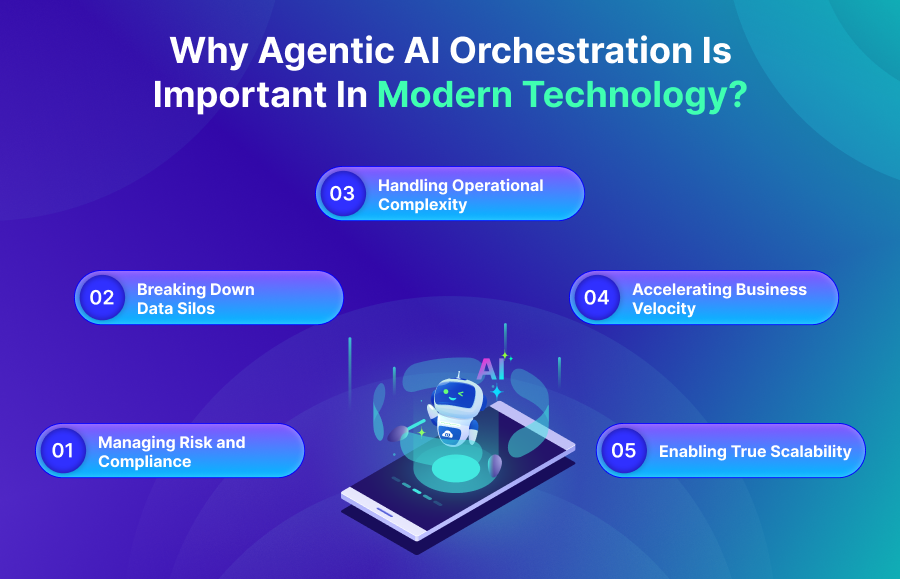
Here’s why orchestration matters:
- Breaking Down Data Silos: When different business units use separate systems (CRM, ERP, HRIS), data becomes fragmented. Orchestration provides a unified platform that connects disparate systems, allowing seamless data flow and real-time synchronization across your entire enterprise ecosystem.
- Handling Operational Complexity: Enterprise workflows involve multiple systems, approval chains, and exception scenarios. Manual processes create bottlenecks and errors. Orchestrated AI agents automate these workflows, eliminate manual handoffs, and adapt to changing conditions without breaking down.
- Accelerating Business Velocity: Faster workflow cycles reduce low-value work time. This speed advantage comes from agents that work 24/7, processing tasks in parallel rather than sequentially.
- Managing Risk and Compliance: As AI agents gain access to business systems, the risk of mistakes increases. Orchestration provides centralized governance, audit trails, and safety guardrails. Every automated decision can be traced, explained, and validated against compliance requirements.
- Enabling True Scalability: Without orchestration, scaling AI means deploying more isolated agents, which increases complexity exponentially. With orchestration, you add capabilities without adding chaos because the central framework manages coordination automatically.
Ready to orchestrate AI across your enterprise systems? Discover how appse AI simplifies deployment.
Agentic AI vs Traditional Automation
The difference between traditional automation and agentic AI orchestration represents a fundamental shift in how businesses approach process optimization.
Traditional automation follows predetermined rules and paths. If X happens, do Y. It works well for repetitive, predictable tasks but breaks when conditions change or exceptions occur. Think of RPA (Robotic Process Automation) bots that copy data between systems or trigger emails based on specific events. These tools need explicit instructions for every scenario.
Agentic AI brings autonomous decision-making into the equation. These agents use large language models and machine learning to understand context, reason through problems, and determine the best course of action without pre-programmed rules.
Here’s how they compare:
| Dimension | Traditional Automation | Agentic AI Orchestration |
|---|---|---|
| Decision-Making | Rule-based, predetermined | Context-aware reasoning |
| Adaptability | Breaks when rules violated | Learns and adapts |
| Scope | Single-task workflows | Multi-step, cross-functional processes |
| Intelligence | Static logic | Dynamic problem-solving |
| Integration | Point-to-point connections | Coordinated multi-system orchestration |
| Human Role | Process executor | Strategic overseer |
Real-world example: A traditional automation might monitor inventory levels and send alerts when stock drops below a threshold. An orchestrated agentic AI system monitors inventory, analyzes sales trends, predicts future demand based on seasonal patterns and market data, automatically triggers replenishment orders with preferred suppliers, adjusts pricing dynamically, and reroutes shipments based on weather forecasts and delivery constraints—all without human intervention.
The key advantage? Traditional automation handles individual tasks. Agentic orchestration manages entire business processes end-to-end, making decisions, adapting to changing conditions, and coordinating across multiple systems simultaneously.
Organizations implementing agentic orchestration report 30-50% acceleration in business processes compared to traditional automation approaches. It’s a transformation difference.
Orchestration vs Single Agent
Many organizations start their AI journey by deploying individual agents for specific tasks: a chatbot for customer service, an agent for data analysis, another for document processing. This approach delivers quick wins but creates problems as you scale.
Single Agent Approach:
A single AI agent operates independently, handling one specific function or domain. For example, you might have an agent that processes invoice data, extracting information and validating formats. It works within its narrow scope but doesn’t coordinate with other business processes.
Limitations:
- Cannot handle complex, multi-step workflows requiring different expertise
- Lacks awareness of broader business context
- Creates data inconsistencies when multiple agents access the same systems independently
- Requires manual intervention to hand off tasks between agents
- Difficult to maintain consistent governance across multiple isolated agents
Orchestration Approach:
An AI agent orchestration framework coordinates multiple specialized agents, enabling them to work together as a cohesive system. Think of it as moving from solo performers to a synchronized team.
Advantages:
- Specialized Expertise: Deploy agents optimized for specific tasks (data validation, document generation, API integration) rather than one generalist agent
- Coordinated Workflows: Agents hand off tasks seamlessly, maintaining context and data consistency
- Parallel Processing: Multiple agents work simultaneously on different aspects of complex workflows
- Centralized Governance: Single orchestration layer manages security, compliance, and monitoring across all agents
- Resilience: If one agent fails, the orchestrator can route work to backup agents or trigger human intervention
Practical Example:
Imagine processing a customer order in an e-commerce business:
Single Agent: One agent tries to handle everything—validating payment, checking inventory, generating shipping labels, updating CRM, sending notifications. It becomes a bottleneck and requires extensive programming for every business rule.
Orchestrated Multi-Agent:
- Payment validation agent verifies transaction
- Inventory agent checks stock across warehouses
- Logistics agent determines optimal fulfillment center
- Shipping agent generates labels and schedules pickup
- CRM agent updates customer records
- Notification agent sends confirmation emails
The orchestrator coordinates timing, manages data flow between agents, handles exceptions, and ensures all steps complete successfully. If inventory is low, it automatically triggers a procurement agent to place restock orders.
Gartner reported a 1,445% surge in multi-agent system inquiries from early 2024 to mid-2025. Leading organizations are implementing orchestrators that coordinate specialist agents rather than deploying one large, monolithic AI system.
What are the Benefits of Agentic AI Orchestration?
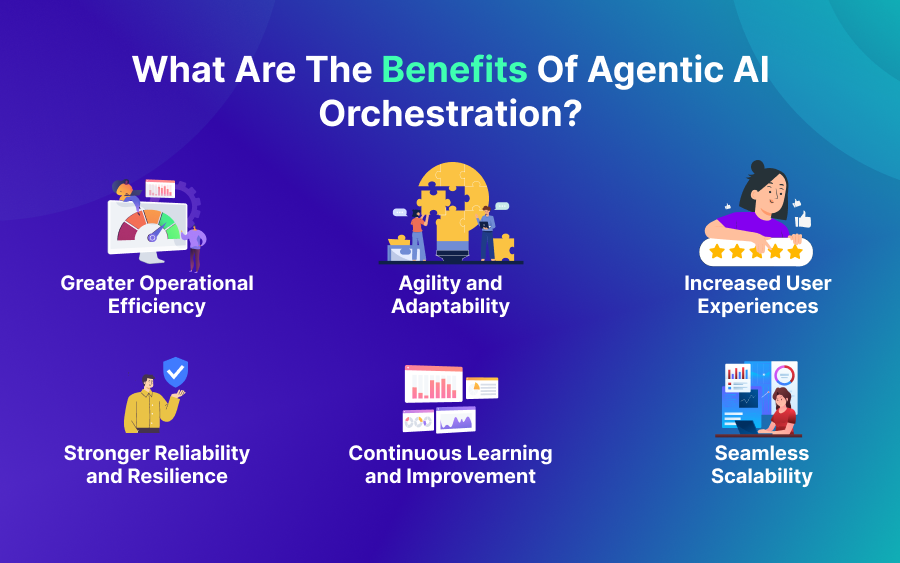
Implementing agentic AI orchestration delivers measurable improvements across operations, customer experience, and bottom-line results. Let’s break down key benefits.
Greater Operational Efficiency
Orchestrated ai agents eliminate manual bottlenecks that slow business processes. They work 24/7 without breaks, processing tasks in parallel rather than sequentially.
Organizations implementing orchestration report automating daily tasks free up employees to focus on strategic work. Manufacturing companies reduce unplanned production line stop through coordinated agents monitoring equipment, supply chains, and quality metrics simultaneously.
The efficiency gains compound over time as agents learn from patterns and optimize workflows continuously.
Agility and Adaptability
Traditional systems break when business conditions change. Orchestrated agentic AI adapts dynamically to new situations without requiring reprogramming.
When supply chain disruptions occur, orchestrated agents automatically reroute shipments, find alternative suppliers, adjust production schedules, and notify affected customers—all within minutes. During peak demand periods, the system scales processing capacity automatically, adding computational resources and activating standby agents as needed.
This adaptability becomes critical in fast-moving markets.
Increased User Experiences
Orchestrated agents deliver faster, more personalized customer interactions by accessing complete context across all touchpoints.
When a customer contacts support, the orchestrated system coordinates multiple agents: one retrieves complete purchase history, another analyzes sentiment and priority, a third checks inventory for replacements, and a fourth accesses knowledge bases for solutions.
The customer gets accurate, comprehensive responses in seconds instead of being transferred between departments.
For enterprise commerce teams, this means fewer order escalations, faster refund approvals, and real-time visibility into SAP, CRM, and logistics systems during a single customer interaction.
Stronger Reliability and Resilience
Orchestration builds fault tolerance into your AI operations. When individual agents encounter errors or unexpected conditions, the orchestrator implements automatic recovery mechanisms.
If an API call fails, the system retries with exponential backoff. If an agent produces questionable results, validation agents flag the output for review. If critical agents go offline, the orchestrator routes work to backup systems or escalates to human operators with full context.
Continuous Learning and Improvement
Orchestrated agents learn from outcomes and optimize performance over time. Machine learning algorithms monitor workflow performance, identify inefficiencies, and suggest improvements automatically.
The system captures data on every execution: which paths work best, where delays occur, what exception scenarios arise. Over time, the orchestrator adapts logic to route work more efficiently, prioritize high-value tasks, and predict potential bottlenecks before they cause problems.
Over time, this directly improves KPIs like order processing cycle time, exception handling rates, and cost per transaction—metrics CIOs and operations heads track closely.
Seamless Scalability
As your business grows, orchestrated AI scales horizontally without architectural changes. Need to process 10x more transactions? The orchestration framework distributes work across additional agents automatically.
This scalability extends beyond computational resources. When you expand into new markets or product lines, you add specialized agents to the orchestration framework without disrupting existing workflows. The central orchestrator integrates new capabilities seamlessly.
Enterprises supporting millions of transactions daily rely on orchestrated architectures that scale processing capacity dynamically based on demand, ensuring performance remains consistent during peak periods without over-provisioning resources during normal operations.
Explore appse AI’s scalable orchestration platform built for enterprise growth.
Implementation Steps of Agentic AI Orchestration
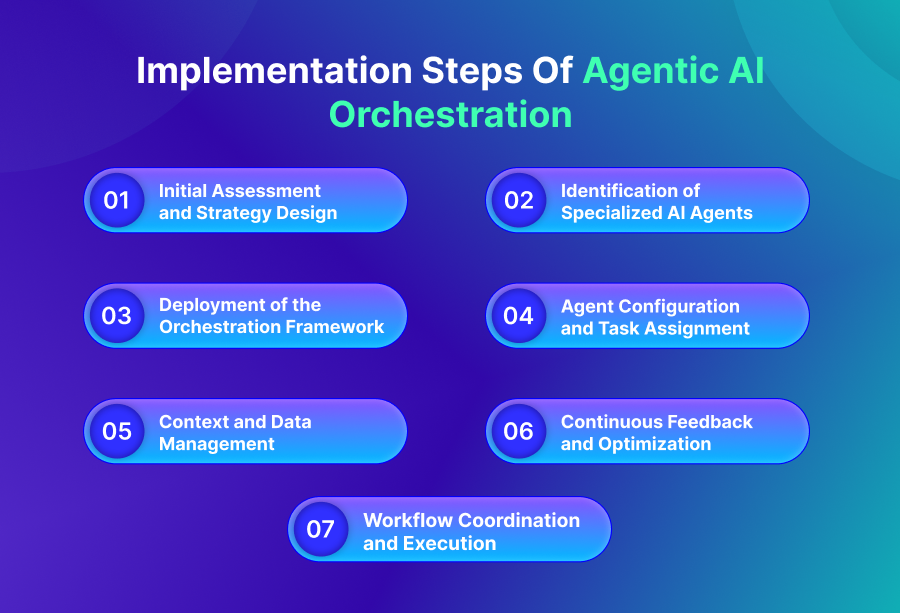
Successfully deploying agentic AI orchestration requires methodical planning and execution. Here’s your roadmap from strategy to production.
Initial Assessment and Strategy Design
Start by understanding your current state and defining clear objectives.
- Conduct a workflow audit: Map existing business processes to identify bottlenecks, manual handoffs, and repetitive tasks that consume significant time. Look for workflows that span multiple systems and departments—these are prime candidates for orchestration.
- Evaluate technical readiness: Assess your current infrastructure. Do your systems have modern APIs that agents can access? Is your data architecture positioned for real-time consumption by AI agents?
- Define success metrics: Establish baseline measurements for processes you plan to automate. Track cycle time, error rates, cost per transaction, and customer satisfaction scores. These benchmarks let you measure orchestration impact accurately.
- Build stakeholder alignment: Secure buy-in from IT, operations, finance, and business leaders. Each group has different concerns—IT wants predictable systems, CFOs need measurable ROI, and business leaders demand both efficiency and adaptability.
Pilots focused on specific, well-defined domains are twice as likely to reach full deployment compared to enterprise-wide initiatives. Choose one high-impact workflow as your initial use case.
Identification of Specialized AI Agents
Determine which specialized agents your orchestration needs to coordinate.
Map capabilities to tasks: Break your target workflow into discrete activities. Does each step require data validation, natural language processing, numerical analysis, document generation, or API integration? Match each activity to agent capabilities.
Types of agents to consider:
- Data processing agents that extract, transform, and validate information
- Decision-making agents that evaluate conditions and determine next actions
- Integration agents that connect to external systems and APIs
- Monitoring agents that track performance and detect anomalies
- Communication agents that handle notifications and user interactions
- Validation agents that verify outputs meet quality standards
Build vs buy decision: For common functions like CRM integration, email processing, or document extraction, leverage pre-built agents from your orchestration platform. Develop custom agents only for proprietary business logic unique to your operations.
Establish what permissions each agent type needs, what data they can access, and what actions they can take autonomously versus requiring human approval.
Deployment of the Orchestration Framework
Choose and implement the technical infrastructure that will coordinate your agents.
Select your orchestration platform: Evaluate options based on your requirements. Enterprise platforms like appse ai offer governance, observability, and scalability out of the box. Open-source frameworks like LangChain or CrewAI provide flexibility but require more technical expertise.
Key platform capabilities:
- Visual workflow designer for modeling agent coordination
- Integration connectors to your existing systems (ERP, CRM, databases)
- Runtime engine that executes workflows and manages agent communication
- Monitoring dashboard showing agent activity, performance, and errors
- Security controls including authentication, authorization, and audit logging
- API gateway for exposing orchestrated workflows to other applications
Infrastructure setup: Deploy the orchestration framework in your preferred environment—cloud, on-premise, or hybrid. Configure connections to your data sources, business systems, and AI model endpoints (like OpenAI, Anthropic Claude, or self-hosted models).
Establish governance policies: Define approval workflows, set rate limits on API calls, configure retry logic for failed operations, and establish escalation paths when agents encounter exceptions they can’t resolve.
Agent Configuration and Task Assignment
Configure each agent’s role, permissions, and data access. Define which decisions agents make autonomously versus when they escalate to humans.
For regulated workflows, enterprises often enforce policy-driven guardrails—such as restricting agents from modifying SAP financial records without approval—while still allowing autonomous execution for low-risk actions
For example, auto-approving payments under $1,000 but requiring review above that threshold.
Workflow Coordination and Execution
Design how agents collaborate to execute complete business processes.
Choose orchestration patterns:
- Sequential orchestration: Agents execute in order, each refining the previous agent’s output
- Concurrent orchestration: Multiple agents work in parallel, with results merged at the end
- Conditional branching: Orchestrator routes work to different agents based on data conditions
- Dynamic handoff: Agents determine in real-time which specialist should handle the next step
- Hierarchical orchestration: A manager agent coordinates subtasks across multiple worker agents
Using your platform’s visual designer, map out the agent coordination logic. Define triggers that start workflows (API calls, scheduled times, database changes, incoming emails), specify decision points where the orchestrator evaluates conditions, set up data transformations between agents, and configure error handling for each step.
Implement human-in-the-loop: Identify decision points where human judgment is required. Design approval interfaces, configure notification channels, and establish escalation procedures when agents encounter ambiguous situations.
Before production deployment, run workflows through test scenarios covering normal operations, edge cases, and failure conditions. Validate that agents coordinate correctly and data flows accurately between systems.
Context and Data Management
Ensure agents have access to the information they need while maintaining data quality and security.
- Build knowledge bases: Create repositories of business rules, product information, customer data, and historical patterns that agents can reference. This gives agents the context needed for informed decisions.
- Implement context passing: As workflows progress through multiple agents, each needs relevant information from previous steps. The orchestrator maintains this context, ensuring agents don’t work with stale or incomplete data.
- Data normalization: Different systems store data in different formats. Implement transformation logic that converts data into standardized formats agents can consistently process. This prevents errors from format mismatches.
- Security controls: Encrypt data in transit and at rest. Implement role-based access controls so agents only see data relevant to their functions. Maintain detailed audit logs tracking what data agents accessed and what actions they took.
Continuous Feedback and Optimization
Deploy, monitor, and refine your orchestration over time for maximum value.
Production rollout: Start with limited scope—perhaps one department or workflow—before expanding enterprise-wide. This phased approach lets you validate performance, identify issues, and build confidence before scaling.
Monitor performance: Track key metrics daily:
- Workflow completion rates and cycle times
- Agent success rates and error frequencies
- System resource utilization
- Business outcome improvements (cost savings, customer satisfaction, revenue impact)
Review analytics monthly to identify inefficiencies.
Teams that operationalize this feedback loop typically see compounding gains, where each optimization cycle reduces manual effort and exception volume further.
Maybe certain agents consistently encounter the same errors, suggesting they need better training data. Perhaps workflow routing logic could be optimized based on learned patterns.
As initial workflows prove successful, identify additional use cases. Leverage lessons learned to deploy new orchestrations faster. Reuse existing agents where possible, adding specialized agents only when needed.
Future Directions of Agentic AI Orchestration
The agentic AI orchestration landscape is evolving rapidly. Understanding emerging trends helps you future-proof your implementation.
- Interoperability standards: Currently, each vendor’s agents use proprietary communication protocols. Open standards will emerge enabling agents from different providers to collaborate seamlessly. This interoperability unlocks hybrid architectures where you combine best-of-breed agents from multiple sources within one orchestration framework.
- Vertical AI solutions: Generic orchestration platforms will give way to industry-specific solutions. Healthcare orchestration will coordinate agents specialized in clinical workflows, claims processing, and patient engagement. Manufacturing orchestration will integrate agents for supply chain, production scheduling, and quality control. These vertical solutions will come with pre-built agents and workflows tailored to industry requirements.
- Economic optimization: Running orchestrated AI systems costs money—API calls to large language models, computational resources, data storage. Future orchestrators will intelligently route tasks to the most cost-effective resources: expensive frontier models for complex reasoning, mid-tier models for standard tasks, and small specialized models for high-frequency execution.
- Autonomous workforce management: Organizations will begin treating AI agents as a “silicon workforce” requiring lifecycle management similar to human employees. This includes onboarding new agents with training data, monitoring performance and retraining when accuracy degrades, promoting successful agents to more complex responsibilities, and retiring agents that no longer deliver value.
- Regulatory frameworks: As AI agents make more consequential business decisions, regulatory requirements will tighten. The EU AI Act is already law with penalties up to €35 million for violations. Future orchestration platforms will need built-in compliance features: explainability showing why agents made specific decisions, audit trails tracking all agent actions, bias detection preventing discriminatory outcomes, and safety controls preventing harmful actions.
- Agent marketplaces: Expect ecosystem development where system integrators and software vendors offer validated, industry-specific agents. Organizations will discover, test, and deploy purpose-built agents from marketplaces directly into their orchestration frameworks—similar to how mobile apps work today. This accelerates deployment from months to days.
- Cognitive architecture evolution: Current agents mostly follow sequential reasoning. Future architectures will implement parallel cognition where multiple reasoning pathways execute simultaneously, with the orchestrator selecting the most promising approach. This mimics human problem-solving more closely and handles ambiguity better.
The trajectory is clear: orchestration moves from optional to essential as AI becomes embedded in every business process. Organizations building orchestration capabilities now position themselves to leverage these advances as they mature.
Conclusion
Agentic AI orchestration represents a fundamental shift from isolated automation to coordinated intelligence.
As enterprises struggle to manage hundreds of applications and fragmented workflows, orchestration provides the central nervous system that enables AI agents to collaborate effectively across systems, departments, and processes.
The market opportunity is massive—$52 billion by 2032—but success requires more than deploying agents. You need enterprise-ready orchestration that integrates with legacy systems, provides governance and security, and scales as your needs evolve.
Start your journey now. Book a demo with appse AI to build an intelligent automation layer that connects systems, powers autonomous AI agents, and drives real-time enterprise decisions.
Frequently Asked Questions
1. What is orchestration in agentic AI?
2. What is the agentic AI orchestration pattern?
3. What is the difference between AI orchestration and agentic AI?
4. How do I implement agentic AI orchestration in enterprise workflows?
5. How do multi-agent systems improve business efficiency?
6. What is an AI agent orchestration platform?
An AI agent orchestration platform coordinates multiple autonomous AI agents, manages workflows, enforces governance, and integrates agents with enterprise systems like ERP, CRM, and eCommerce platforms.
7. How does agentic AI orchestration improve SAP-centric workflows?
8. Is agentic AI orchestration safe for enterprise use?
Yes. Enterprise orchestration platforms include access controls, approval workflows, audit logs, and explainability layers to ensure safe AI execution.
Leave a Reply