How we interact with artificial intelligence is changing quickly. We’ve moved beyond simple chatbots that answer questions to AI systems that can actually think, plan, and act on their own.
This evolution brings us to agentic AI—autonomous systems that don’t just respond but take initiative to solve complex problems across your business.
If you’ve ever wished your software could handle entire workflows without constant supervision, you’re thinking about agentic AI. These systems perceive their environment, make decisions based on goals, and execute multi-step tasks across different platforms.
The market agrees this is transformative: projected to grow from $7.84 billion in 2025 to $93.2 billion by 2032.
Let’s explore what makes agentic AI different and how it’s reshaping enterprise operations.
- Agentic AI operates autonomously – Unlike traditional AI that waits for instructions, agentic systems independently perceive context, plan actions, and execute multi-step workflows across applications without constant human supervision.
- It’s goal-driven, not task-driven – You define what needs to be achieved (reduce customer churn, reconcile invoices), and the system determines how to get there, adapting its approach based on real-time conditions.
- The market is exploding – Projected to grow from $7.84 billion in 2025 to $93.2 billion by 2032, driven by measurable ROI in efficiency, scalability, and continuous improvement.
- Real businesses are seeing results – From Walmart’s autonomous restocking to UC San Diego Health cutting sepsis deaths by 17%, agentic AI is delivering tangible outcomes across industries today.
- Implementation requires guardrails – Success means starting with well-defined use cases, establishing safety boundaries, and balancing automation potential with proper governance and human oversight.
What Is Agentic AI?
Agentic AI refers to autonomous artificial intelligence systems that can:
- Independently perceive context
- Reason about objectives
- Plan multi-step actions
- Execute tasks across applications
without requiring constant human intervention or step-by-step prompting.
Unlike traditional AI that waits for instructions, agentic AI operates with agency. It understands what needs to be accomplished, determines the best approach, and takes action to achieve specific outcomes.
Think of it as the difference between a tool that needs an operator versus a colleague who can handle assignments independently.
These systems combine large language models with the ability to call external tools, access data sources, and interact with business applications.
At an architectural level, agentic AI typically consists of planning agents, execution agents, memory layers, and orchestration logic that coordinates tools, APIs, and human checkpoints.
When you assign a goal like “reconcile this month’s invoices and flag discrepancies,” an agentic AI system doesn’t just generate a report. It accesses your accounting software, cross-references data, identifies issues, and can even initiate corrective workflows.
Ready to automate complex workflows with AI? Start with Appse AI’s AI-powered workflow automation to see how autonomous agents can transform your operations.
Key Characteristics of Agentic AI
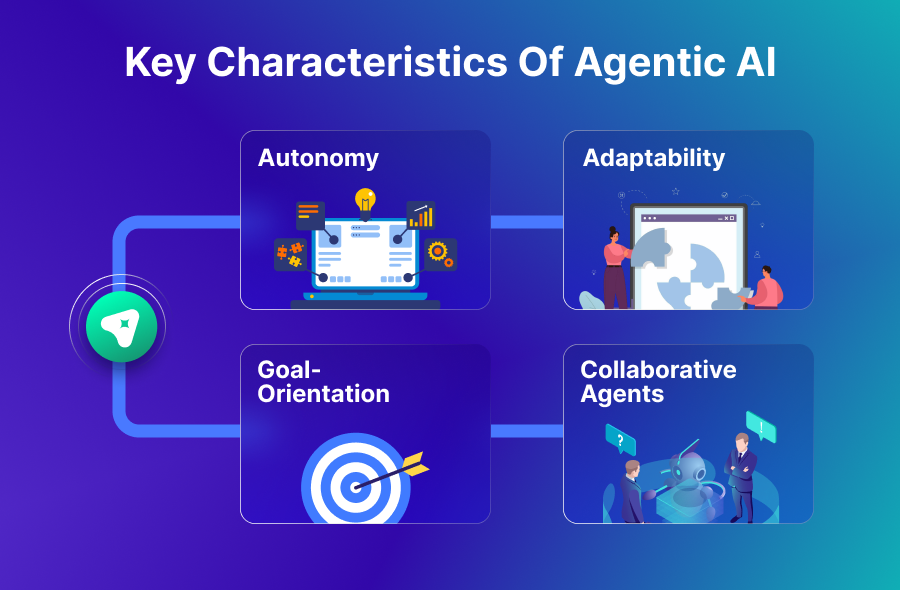
What separates agentic AI from other forms of artificial intelligence? Five core characteristics define these systems and explain why they’re generating such intense business interest.
Autonomy
The system can operate independently once given a goal. You don’t need to micromanage every step or provide constant prompts. The AI agent perceives what’s happening in its environment, decides what actions to take, and executes those actions without waiting for permission at each stage.
This autonomy extends across workflows. An agentic system monitoring your supply chain doesn’t just alert you to a potential stockout. It analyzes demand patterns, checks supplier availability, evaluates pricing, and can automatically initiate purchase orders based on predefined parameters and real-time conditions.
Levels of autonomy vary by implementation. Some agents operate fully independently within defined boundaries, while others maintain human-in-the-loop checkpoints for critical decisions.
Adaptability
Agentic AI systems learn and adapt based on outcomes and changing conditions. Unlike rigid rule-based automation that breaks when conditions change, these systems use probabilistic models and continuous learning to respond to new situations.
When an agentic AI encounters an unexpected scenario—like a supplier being out of stock or a customer requesting an unusual configuration—it doesn’t simply error out. It evaluates alternatives, applies learned patterns from similar situations, and adjusts its approach accordingly.
This adaptability comes from the underlying machine learning models that power these systems. The system becomes more effective over time without requiring manual reprogramming.
Goal-Orientation
Agentic AI focuses on outcomes rather than tasks. You define what needs to be achieved, and the system determines how to get there. This goal-driven behavior distinguishes agents from traditional software that follows predetermined steps regardless of whether they lead to the desired result.
Consider the difference: Traditional automation executes “send this email at 9 AM every Monday.” An agentic system pursues “ensure customers receive timely communication about their orders.”
The agent evaluates whether an email is the right channel, determines optimal timing based on customer behavior, and adjusts content based on order status.
This goal orientation enables agentic AI to navigate complexity. When pursuing an objective like “reduce customer churn,” the system can evaluate multiple intervention strategies, test different approaches, and continuously optimize toward that goal rather than mechanically executing a fixed playbook.
Collaborative Agents
Modern agentic AI implementations often involve multiple specialized agents working together. Rather than one monolithic system trying to handle everything, organizations deploy agent networks where each agent has specific expertise and capabilities.
A customer service workflow might involve separate agents for intent classification, knowledge retrieval, response generation, and action execution. These agents communicate, share context, and coordinate their activities to deliver a seamless outcome. One agent might gather customer history while another analyzes the current issue and a third drafts a personalized resolution.
This multi-agent orchestration enables handling of complex scenarios that no single agent could manage alone.
- Parallel (speeding up processing)
- Sequentially (where one agent’s output feeds the next)
- Or collaboratively (jointly solving problems that require multiple perspectives)
Natural Language Interface
Agentic AI systems understand and respond to natural language, making them accessible to business users without coding skills. You can describe what you need in plain English rather than learning specialized syntax or programming languages. This natural language capability extends beyond simple queries. You can provide context, clarify requirements, and refine instructions through conversation. The agent understands intent, asks clarifying questions when needed, and confirms understanding before executing critical actions. For enterprise adoption, this interface democratizes AI capabilities. Your operations team can deploy automated workflows, your finance team can set up reconciliation agents, and your sales team can create lead qualification systems without waiting for IT resources or learning technical skills.How Agentic AI Works?
Understanding the operational mechanics of agentic AI helps clarify why these systems deliver such different results from traditional automation. The process follows a continuous cycle of perception, planning, action, learning, and orchestration.
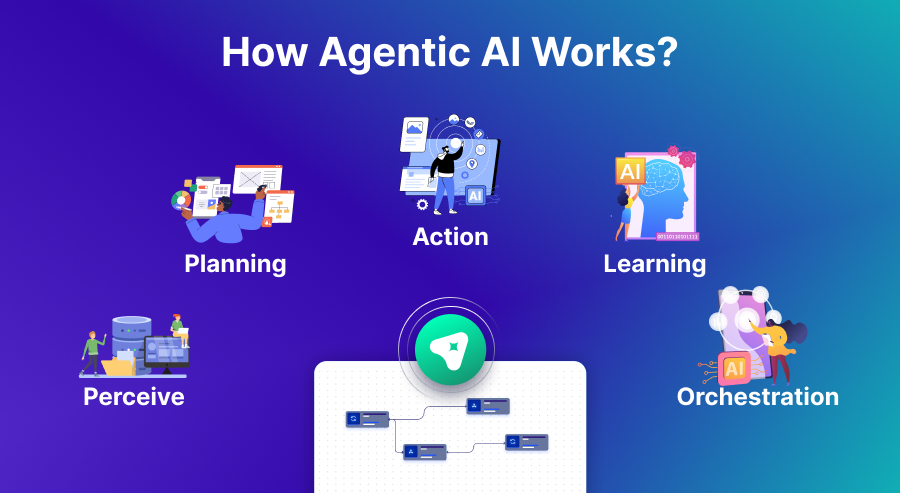
Perceive
The perception phase involves gathering and interpreting information from the environment. Agentic AI systems collect data from multiple sources—APIs, databases, documents, user inputs, and real-time system states. They don’t just ingest raw data but decode it for meaning and context. When monitoring a customer service queue, the agent doesn’t just see “50 tickets pending.” It perceives patterns like “15 tickets about login issues opened in the last hour, concentrated among mobile users, coinciding with the latest app update.” This contextual awareness informs better decision-making. Perception capabilities have advanced significantly with modern large language models that can process both structured data (like database records) and unstructured information (like customer emails or internal documentation).Planning
With context established, the agent develops a plan to achieve its goal. This planning phase involves breaking complex objectives into manageable steps, identifying required resources, and determining the optimal sequence of actions. Planning isn’t just linear task lists. Sophisticated agents evaluate multiple possible approaches, consider trade-offs, and select strategies based on current conditions. If the first approach hits an obstacle, the agent can replan rather than simply failing. The planning process leverages both deterministic logic (clear rules and procedures) and probabilistic reasoning (evaluating likely outcomes based on learned patterns). An agent scheduling a delivery considers hard constraints like “warehouse closes at 6 PM” alongside probabilistic factors like “traffic typically increases after 4 PM.”Action
This is where the agent executes its plan by interacting with external systems. Actions might include querying databases, calling APIs, updating records, sending notifications, or triggering workflows in other applications. The agent maintains awareness of action results to determine next steps. Modern agentic systems can perform complex sequences of actions across multiple platforms. An agent processing a customer refund might verify the original transaction in your payment system, check inventory status in your warehouse management system, update the order in your ERP, trigger a notification through your customer service platform, and log the complete interaction in your CRM. Action capabilities depend on proper integration infrastructure. Tools like Appse AI’s Unified API enable agents to seamlessly interact with hundreds of business applications through standardized interfaces, eliminating the integration complexity that often stalls AI initiatives.Learning
After executing actions, the agent evaluates outcomes and incorporates lessons for future performance. This learning happens continuously, not just during a training phase. The system identifies which approaches produced desired results and adjusts its decision-making accordingly. Learning mechanisms vary. Some agents use reinforcement learning, receiving feedback on whether their actions achieved the intended goal. Others employ supervised learning from human corrections. Advanced systems combine multiple learning approaches to improve across different dimensions simultaneously. A practical example is invoice reconciliation. If an agent flags false discrepancies and receives human correction, it adjusts confidence thresholds and matching logic for future cycles, reducing review workload over time.Orchestration
Orchestration coordinates multiple agents and tools to accomplish complex workflows. This involves managing data flow between agents, handling dependencies (ensuring one agent completes before another starts), and maintaining overall workflow coherence. Orchestration patterns include:- Prompt chaining (where one agent’s output feeds into another’s input)
- Routing (directing work to specialized agents based on task type)
- Parallelization (running multiple agents simultaneously)
- Iterative patterns (where planner and critic agents refine outputs through multiple cycles)
Agentic AI vs Other AI
Generative AI vs. Agentic AI
Generative AI focuses on creating new content—text, images, code, or other media—based on learned patterns from training data. Systems like ChatGPT or Midjourney excel at generation but don’t inherently act or pursue goals. Agentic AI extends generative capabilities with autonomous action. While generative AI might draft an email response to a customer complaint, agentic AI would analyze the complaint, check order status across your systems, determine appropriate resolution, update relevant records, send the response, and schedule follow-up. Think of generative AI as a powerful creative tool that needs an operator. Agentic AI is that tool combined with the operator’s decision-making and execution capabilities. Many agentic systems incorporate generative models as one component within a broader autonomous workflow. The distinction matters for implementation. If your need is content creation or assistance with specific tasks, generative AI tools work well. If you want systems that independently manage end-to-end processes, you need agentic capabilities.Not Just a Chatbot
Chatbots engage in conversation, typically answering questions or providing information through a text interface. Even sophisticated chatbots powered by large language models remain fundamentally reactive—they respond to user inputs but don’t initiate actions or pursue objectives independently. Agentic AI can include conversational interfaces but goes far beyond them. An agent doesn’t wait for users to ask questions. It monitors conditions, identifies situations requiring intervention, and takes appropriate action proactively.Beyond RPA
Robotic Process Automation (RPA) automates repetitive, rule-based tasks by mimicking human interactions with software interfaces. RPA bots follow predetermined scripts—”click here, enter this data, submit the form”—with no understanding of context or ability to adapt. Agentic AI handles the uncertain, variable scenarios where RPA breaks down. When an RPA bot encounters a website layout change or unexpected error message, it typically fails and requires human intervention or script updates. An agentic system evaluates the new situation and determines an appropriate response. The technical difference is fundamental. RPA executes fixed sequences of actions regardless of whether they make sense in current context. Agentic AI evaluates context continuously and adjusts its approach based on real-time conditions and learned patterns.Benefits of Agentic AI
Why is the agent AI market expected to grow 44.6% annually? Because these systems deliver measurable business value across efficiency, quality, and scale dimensions that traditional automation can’t match.
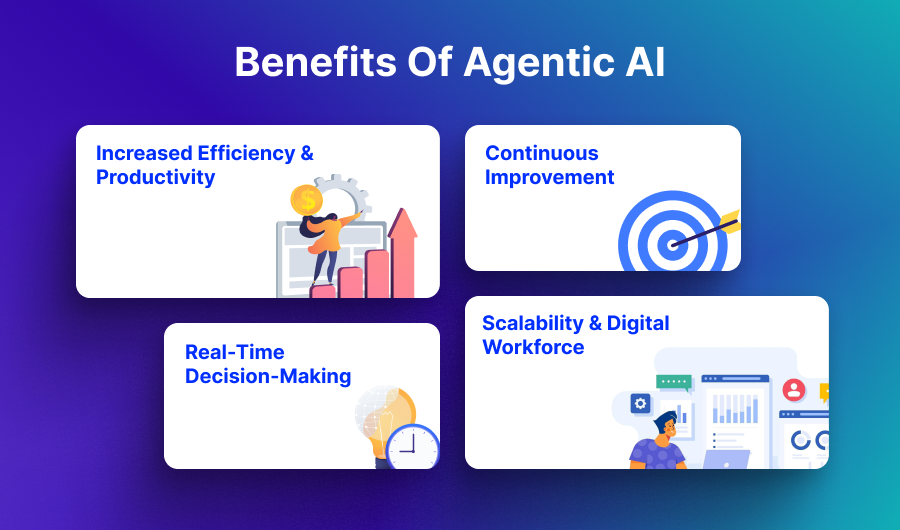
Increased Efficiency & Productivity
Agentic AI automates entire workflows that previously required human intervention at multiple decision points. This eliminates bottlenecks where work waits in queues for someone to review, approve, or route it to the next step. Walmart’s AI Super Agent autonomously forecasts demand per SKU per store and initiates just-in-time restocking without human involvement. Efficiency extends beyond speed to resource optimization. When AI agents handle routine decision-making, your team focuses on exceptions, strategy, and high-value activities that genuinely require human expertise.Continuous Improvement
Unlike static automation that performs identically until someone reprograms it, agentic AI improves through operation. The system learns which approaches work best, identifies patterns in successful outcomes, and progressively refines its decision-making. This continuous improvement compounds over time. Initial deployments might achieve 70-80% accuracy on complex tasks, requiring human review of edge cases. Six months later, the same agent handles 90-95% autonomously as it learns from corrections and accumulates experience with unusual scenarios.Real-Time Decision-Making
Agentic AI operates at machine speed, evaluating conditions and taking action in milliseconds rather than hours or days. This real-time capability enables responses that wouldn’t be feasible with human decision-making latency. UC San Diego Health’s COMPOSER system monitors 150 live data points the moment patients enter the emergency department. In a 6,000 patient case study, this real-time AI agent reduced sepsis deaths by 17% by flagging risk hours before symptoms became obvious to clinical staff.Scalability & Digital Workforce
Traditional scaling means hiring more people as your business grows. Agentic AI scales without proportional headcount increases. Deploy additional agent instances to handle 10x workflow volume without 10x staff growth. This scalability advantage particularly benefits mid-market companies competing against larger enterprises. With agentic systems handling operational workflows, a lean team can deliver service quality and processing capacity previously requiring much larger organizations. The concept of a “digital workforce” where AI agents work alongside human employees is transitioning from theory to practice. Accenture predicts that by 2030, AI agents will be the primary users of most enterprises’ internal digital systems, with humans focusing on oversight, strategy, and exception handling.Personalization at Scale
Agentic AI can deliver individualized experiences to every customer without the cost of personal service representatives. Agents evaluate each customer’s history, preferences, current context, and predicted needs to customize interactions. This personalization extends across all touchpoints. Marketing agents determine optimal messaging and timing for each prospect. Customer service agents tailor support approaches based on technical sophistication and communication preferences. Sales agents customize proposals based on company size, industry, and buying patterns. The “at scale” part is crucial. A human can personalize interactions with dozens or hundreds of customers. An agentic system personalizes millions of interactions simultaneously while maintaining consistency with your brand and business rules. Want to see how agentic AI can automate your specific workflows? Talk to our team about deploying autonomous agents tailored to your business needs.Real-World Use Cases & Examples of Agentic AI
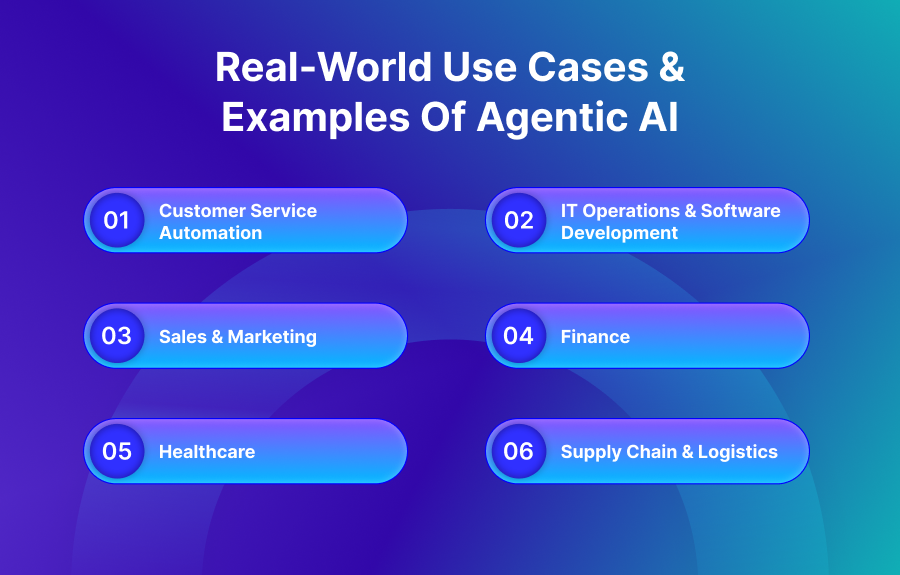
The business value of agentic AI becomes concrete when you see it solving actual operational challenges. Here are implementations delivering measurable ROI across different functions.
- Customer Service Automation: Agentic systems proactively resolve customer issues, handle inquiries 24/7, and execute solutions like refunds or account adjustments within conversational flow, delivering consistent service quality.
A B2B SaaS company used agentic AI to monitor support tickets, classify intent, check CRM history, trigger refunds in Stripe, and update Salesforce automatically. Resolution time dropped by 41%, with zero increase in support headcount.
- IT Operations & Software Development: Agents handle tier-1 support, diagnose issues, provision resources, and assist with code generation, testing, and debugging—scaling technical support without increasing headcount.
- Sales & Marketing: AI agents qualify leads, personalize outreach, manage CRM updates, and automatically optimize campaign performance by testing variations and adjusting targeting in real-time.
- Finance: Agents automate invoice processing, payment reconciliation, expense approvals, and compliance monitoring while achieving 99.5%+ accuracy and flagging anomalies for human review.
- Healthcare: Diagnostic agents analyze patient data and medical imaging to identify conditions faster, while also optimizing scheduling, treatment plans, and revenue cycle management processes.
Supply Chain & Logistics: Agents monitor inventory, demand patterns, and supplier performance to make thousands of micro-decisions that optimize flow from sourcing through delivery, reducing costs and preventing stockouts.
Challenges and Considerations for Agentic AI
Despite compelling benefits, agentic AI implementations face real challenges that require thoughtful approaches. Understanding these issues helps organizations deploy agents successfully rather than joining the 40% of projects Gartner predicts will be canceled by 2027.
Risk of “Going Off-Rails”
Autonomous systems can make decisions that diverge from intended behavior, especially when encountering edge cases. An agent might optimize for a narrow metric in ways that undermine broader objectives.
Successful implementations address this by:
- Defining clear boundaries around agent authority and decision-making power
- Implementing safety runtimes that enforce content and action filters
- Starting with narrow responsibilities before expanding scope as performance is verified.
Multi-Agent Complexity
While multi-agent systems enable complex workflows, they introduce coordination challenges around: sharing context and avoiding conflicting actions between agents, debugging issues when multiple agents are involved, and maintaining end-to-end traceability across agent networks.
Organizations need comprehensive logging and orchestration tools to manage these complexities effectively.
Debugging
AI agents operate using probabilistic models rather than deterministic code, making debugging fundamentally different from traditional software. The same inputs might produce different outputs, complicating issue reproduction and root cause analysis.
When multi-agent systems are involved, tracing problems becomes even more complex. An error might originate from one agent but only surface several steps later in the workflow, making it difficult to identify where things went wrong.
Organizations need comprehensive logging of agent reasoning, decision points, and action sequences. Without detailed audit trails, teams struggle to understand why an agent took a specific action or made a particular decision, delaying issue resolution and system improvements.
Transparency
Unlike traditional software with clear if-then logic, AI agents make decisions based on complex pattern recognition and learned behaviors. This “black box” nature creates challenges when stakeholders need to understand how conclusions were reached.
Transparency is especially important in regulated industries where decisions must be defensible to regulators, auditors, and customers. A loan denial, insurance claim rejection, or medical recommendation requires clear explanation of the factors that influenced the agent’s decision.
Organizations should implement explainable AI techniques that surface key factors driving agent decisions. This includes maintaining human-readable logs of reasoning processes, highlighting which data points most influenced outcomes, and providing confidence scores that indicate decision certainty. Appropriate human oversight should be maintained for high-stakes decisions where transparency and accountability are paramount.
Ethics and Security
Agentic AI introduces new attack surfaces including prompt injection and system exploitation risks. Key considerations include:
- Implementing encryption
- Role-based access controls
- Regular security assessments
- Addressing algorithmic bias
- Data privacy concerns
- Managing workforce transitions thoughtfully as automation scales
Security and governance frameworks must ensure agents operate within policy, legal requirements, and organizational values while maintaining appropriate human oversight for high-stakes decisions.
Future Trends of Agentic AI
Where is this technology heading? Several trends are shaping the next evolution of agentic AI and its impact on business operations.
Multi-Agent Systems Becoming Dominant
Rather than monolithic AI attempting to handle everything, organizations are deploying specialized agent networks where each agent excels at specific tasks.
Platform Consolidation Accelerating
Major technology providers are integrating agentic capabilities into their ecosystems. OpenAI launched ChatGPT Agent integrating Operator and Deep Research functionalities. Microsoft expanded Dynamics 365 with enhanced Copilot capabilities. Google introduced its Agent Space platform. IBM released tools for building AI agent networks with AWS integration.
From Experimentation to Production
Organizations are moving from pilots to production deployment using phased approaches—starting with early pilots that deliver tangible wins, build trust in AI capabilities, and fund the next investment phase. This stepwise strategy reduces risk while proving impact.
Industry-Specific Transformation
Financial services led with 5.6% CAGR in 2025, but automotive adoption is advancing at 42.1% CAGR driven by supply chain and predictive maintenance use cases. Healthcare, retail, and manufacturing are all seeing rapid agentic AI deployment tailored to sector-specific workflows.
AI Infrastructure Evolution
Current architectures designed for conventional applications struggle with the scale and complexity agentic systems demand. Organizations are investing in AI-specific infrastructure including enhanced compute capacity, specialized networking, and orchestration platforms purpose-built for agent coordination.
Maturing Governance Frameworks
The EU AI Act entered force in 2024 with maximum penalties of €35 million or 7% of global annual turnover for certain violations. Organizations worldwide are developing responsible AI practices including safety runtimes, evaluation protocols, and risk mitigation strategies.
Shifting Skills and Talent Requirements
Context engineering is emerging as the critical skill for AI developers—understanding how to provide agents with the right information and tools to achieve objectives. Security teams are training against OWASP and ATLAS threat models specific to AI systems.
Conclusion
Agentic AI represents a fundamental shift in how businesses use artificial intelligence. These autonomous systems move beyond content generation and conversational interfaces to independently perceive conditions, plan actions, execute workflows, and continuously improve performance across your enterprise operations.
Success requires thoughtful implementation. Organizations should start with well-defined use cases, establish appropriate guardrails, invest in integration infrastructure, and adopt phased approaches that build capability incrementally.
The winners will be those who balance automation potential with proper governance and human oversight.
Ready to explore how agent AI can transform operations? Start using Appse AI to deploy autonomous workflows that execute across your enterprise systems. Schedule a consultation to discuss your specific automation needs.
Frequently Asked Questions
1. What is agentic AI in simple terms?
Agentic AI is an autonomous enterprise AI system that understands goals, plans actions, and executes workflows across business applications with minimal supervision. Unlike traditional AI tools that wait for prompts, agentic AI actively decides what to do next based on context, outcomes, and predefined objectives.
2. How does agentic AI work in enterprise environments?
Agentic AI works by continuously cycling through perception, planning, action, learning, and orchestration. It connects to enterprise systems such as ERP, CRM, ITSM, and data warehouses, interprets real-time signals, plans next steps, executes actions through APIs, and improves decisions based on feedback and results.
3. How is agentic AI different from generative AI?
Generative AI focuses on creating content like text, images, or code based on prompts. Agentic AI goes beyond generation by taking autonomous action. It uses generative AI as one component, but adds goal-driven planning, system integrations, and execution capabilities to complete end-to-end business workflows.
4. Is agentic AI just an advanced chatbot?
No. While agentic AI may use conversational interfaces, it is not limited to responding to questions. Agentic AI proactively monitors systems, detects situations requiring action, makes decisions, and executes workflows without waiting for user input, which fundamentally differentiates it from chatbots.
5. What is agentic AI architecture?
Agentic AI architecture typically includes planning agents, execution agents, memory layers, orchestration logic, and integration APIs. This architecture enables agents to coordinate actions, share context, enforce guardrails, and interact safely with enterprise applications while maintaining auditability and control.
6. What are the main benefits of agentic AI for businesses?
Agentic AI delivers increased operational efficiency, real-time decision-making, continuous process improvement, and scalability without proportional headcount growth. Businesses use agentic AI to reduce manual effort, minimize errors, accelerate response times, and personalize experiences across large customer and data volumes.
7. How does agentic AI compare to RPA?
RPA follows fixed, rule-based scripts and breaks when conditions change. Agentic AI understands context and goals, allowing it to adapt dynamically to new scenarios. This makes agentic AI better suited for complex, variable workflows where decision-making and system coordination are required.
8. Is agentic AI safe and secure for enterprise use?
Agentic AI can be deployed safely when implemented with proper guardrails, role-based access controls, audit logs, and human-in-the-loop approvals for high-risk actions. Enterprise-grade agentic AI platforms also include security measures to prevent misuse, data leakage, and unauthorized actions.
9. What industries benefit most from agentic AI?
Industries with complex workflows and high decision velocity benefit most from agentic AI. These include healthcare, financial services, retail, manufacturing, SaaS, logistics, and customer service operations. Any organization managing multiple systems and real-time decisions can gain value from agentic AI.
10. Do I need technical or coding skills to use agentic AI?
Not necessarily. Modern agentic AI platforms offer no-code or low-code interfaces that allow business users to define goals and workflows using natural language or visual builders. Developers can extend functionality when needed, but most operational use cases do not require deep coding expertise.
Leave a Reply